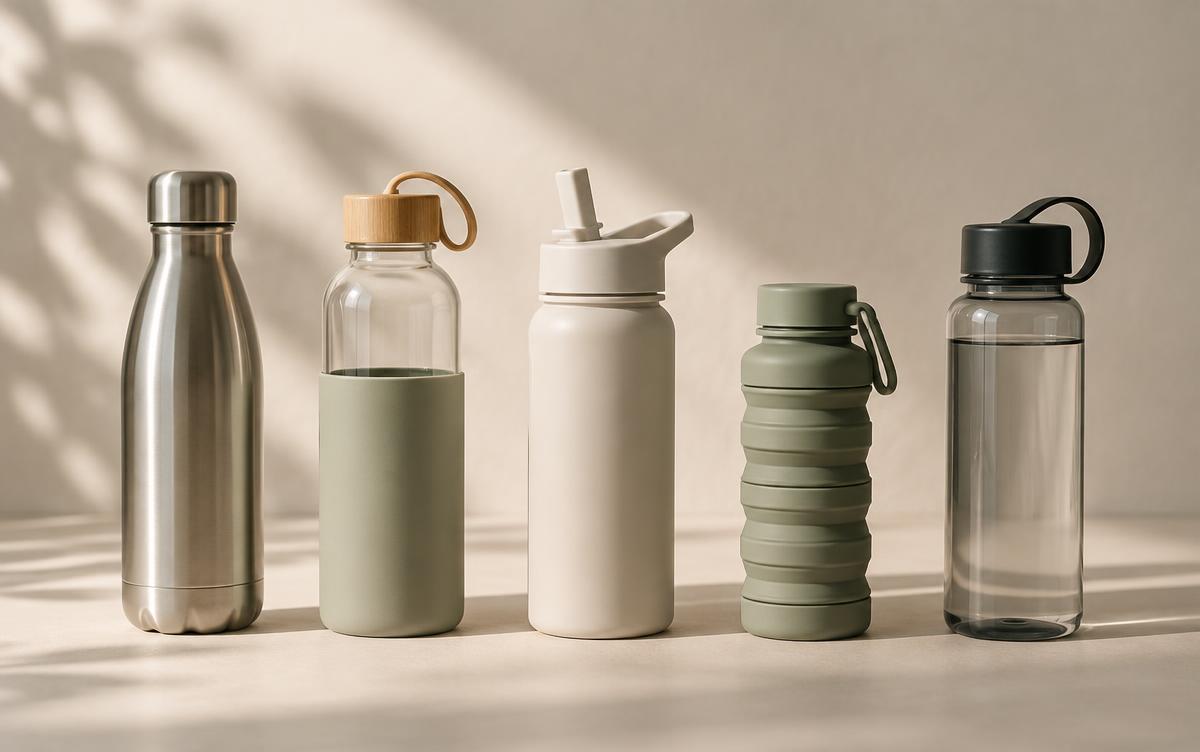
A small reflection on everyday objects and the things that become part of us.
A water bottle has a pretty simple job:
carry water and keep it contained. In theory, almost any closable cylinder could do that.
So why are there so many different designs? Straws, handles, insulation, shapes, colors, materials…
If they all hold water, why do we care which one we use?
I started thinking about this and found three reasons that go beyond function.
01 — IT SAYS SOMETHING ABOUT US.
A bottle is something we carry around, leave on our desks, and take to the gym.
Its appearance can say something about our taste, just as the objects we choose often reflect our personality.
Aesthetics might seem secondary to function, but it can change how we feel about a product. This
research from Google explores the relationship between beauty and usability.
Sometimes we choose an object because it works for us.
Sometimes because it feels like us.
02 — IT CHANGES THE EXPERIENCE.
Two bottles can hold the same amount of water and
still feel completely different to use.
Can you open it with one hand? Is it easy to carry? Does it fit in your bag? Do you drink through a straw or directly from the opening?
Small decisions change how a product fits into our lives. As Don Norman explains in his article on
affordances and design, the possibilities for interacting with an object are part of how we understand and use it.
Design isn't only about what something does. It's also about how it feels to use it.
03 — IT STARTS TO FEEL LIKE OURS.
This is my favorite part.
Sometimes we see an object and immediately think, that's me. We might not know exactly why. Maybe it reflects our taste, reminds us of something, or simply fits the way we live.
Research on
objects and self-identity explores how the things we own can become connected to who we are.
And our relationship with an object can grow over time. We take it places, make it part of our routines, and adapt it to our lives. Something designed by another person becomes something that feels like ours.
Don Norman explores a related idea in this short video about
emotional design: our experience of a product goes beyond its practical function.
DESIGN IS CLOSER THAN WE THINK.
We rarely think about the design of a bottle when we take a sip. We simply use it.
But behind that simplicity are decisions about form, function, materials, and the person who will eventually use it.
And perhaps that's what I find beautiful about design:
someone can create an object without knowing who will own it, and that person can eventually make it part of their identity.